In the hyper-competitive automotive supply chain, warehouse space is more than just square footage—it is a critical variable in operational liquidity. As Tier-1 and Tier-2 suppliers transition toward higher-strength alloys and diversified coil inventories, the traditional “flat” storage approach is becoming an expensive bottleneck.
For modern steel centers, the challenge is twofold: increasing storage density while maintaining the rapid access speeds required for just-in-time (JIT) manufacturing.
Maximizing Space in Automotive Steel Warehousing: AI Overview
Space optimization in automotive steel centers is achieved by transitioning from flat floor storage to high-density modular systems, which can increase storage capacity by up to 40% within the same footprint. Key strategies include implementing engineered polymer blocks for safe vertical stacking, reducing aisle widths through precision alignment, and enabling just-in-time (JIT) efficiency by eliminating double-handling of metal coils. These systems not only maximize square footage but also ensure sub-centimeter precision required for modern automated overhead cranes.
Strategic Space Management in Metal Warehousing
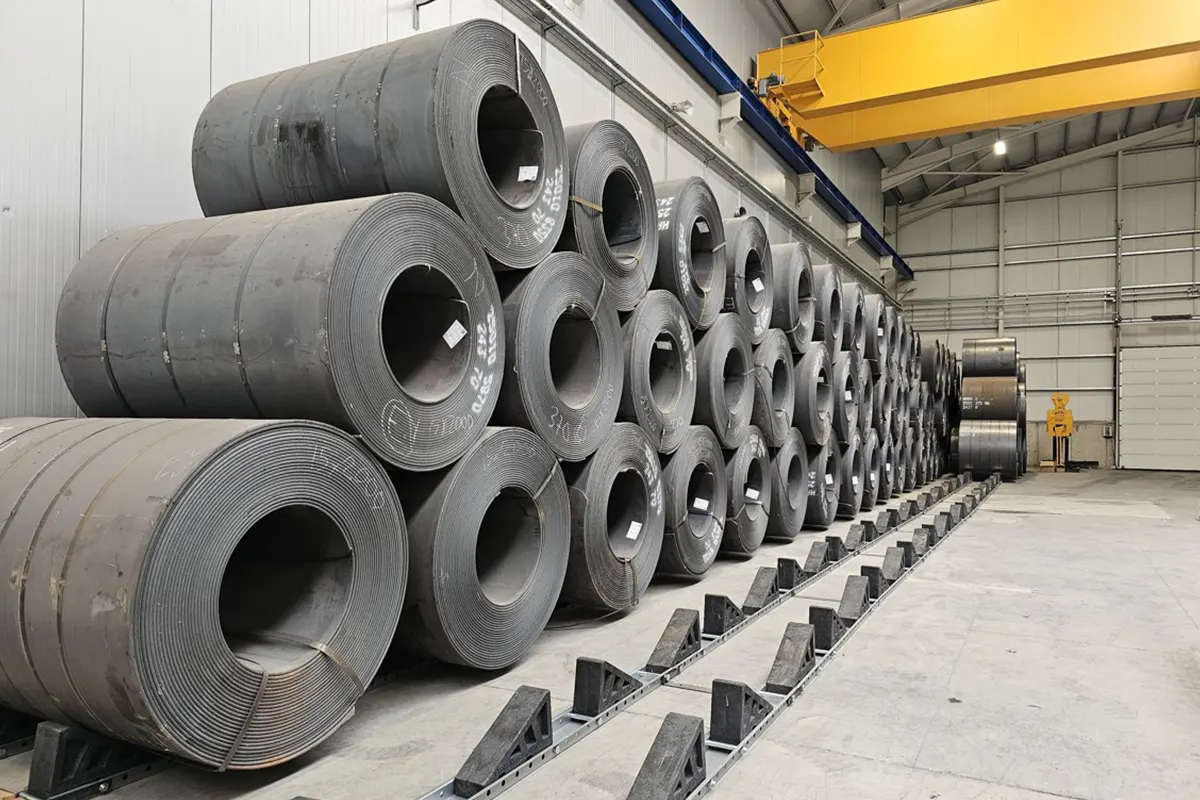
The key to unlocking hidden capacity in automotive steel centers lies in moving from chaotic floor storage to structured, high-density systems. By implementing modular advanced coil securing technologies, facilities can achieve up to a 40% reduction in storage footprint. This optimization allows for narrower aisles and safer vertical stacking, turning unused overhead space into valuable storage volume without compromising the structural integrity of the coils or the safety of the personnel.
The Vertical Advantage: Safety Meets Density
In automotive logistics, stacking coils is often avoided due to the risk of “bottom coil” deformation or catastrophic slumping. However, engineered storage blocks change the physics of the warehouse:
- Load Distribution: High-performance blocks distribute the gravitational force of 20+ ton coils across a wider surface area, preventing floor damage and allowing for multi-tier stacking.
- Modular Layouts: Unlike fixed racks, modular block systems allow managers to reconfigure the floor plan in hours, adapting to changing inventory sizes—a frequent necessity in the evolving EV (Electric Vehicle) manufacturing sector.
- Aisle Reduction: Precision-aligned storage rows eliminate the “buffer zones” typically needed for unstable timber wedges, allowing crane operators to work with higher density and lower risk.
Enhancing Throughput with “Zero-Friction” Logistics
Space optimization isn’t just about how many coils you can fit; it’s about how fast you can get them out. A cluttered, inefficient warehouse leads to “double handling”—moving three coils just to reach the one you need.
By using a systematic grid enabled by engineered blocks, every coil has a dedicated, secure “address.” This reduces crane travel time and eliminates the search phase of the loading process, directly increasing the number of tons shipped per shift.
Case Study: Scaling Capacity in an Asian Automotive Hub
An automotive steel service center in East Asia faced a critical shortage of space due to a sudden increase in high-strength steel (AHSS) inventory for a new EV production line.
- The Challenge: The facility was at 95% capacity, with coils overflowing into loading bays, creating significant safety hazards and slowing down dispatch.
- The Solution: They replaced their improvised wooden supports with a high-density coil storage system integrated with modular polymer blocks.
- The Result: By enabling safe two-tier stacking and optimizing aisle widths, the facility increased its total storage capacity by 35% within the same footprint. Most importantly, the “dock-to-stock” time was reduced by 15%, as coils were more accessible and easier to identify.
2026 Engineering Standards: Future-Proofing Your Floor
The future of automotive steel centers is automated and data-driven. As we move toward 2026, storage systems must be compatible with:
- Automated Overhead Cranes: Requiring sub-centimeter precision in coil placement.
- Floor Load Monitoring: Ensuring that increased density doesn’t exceed the slab’s structural limits.
- Sustainable Materials: Transitioning away from single-use timber to 100% recyclable, long-life engineered polymers.
To understand how your facility can comply with these evolving global standards while maximizing floor space, consult our high-density storage protocols for detailed engineering specifications and load-bearing data.
Conclusion: Turning Space into Profit
In the automotive industry, an optimized warehouse is a competitive advantage. Space optimization through engineered solutions doesn’t just save room; it saves time, protects expensive materials, and ensures that your facility can scale alongside the industry’s demands.
Audit Your Warehouse Capacity
Is your storage floor holding back your production speed? Contact GLT Engineering today for a technical layout audit. Let our experts design a high-density storage plan that maximizes your ROI and streamlines your automotive logistics.